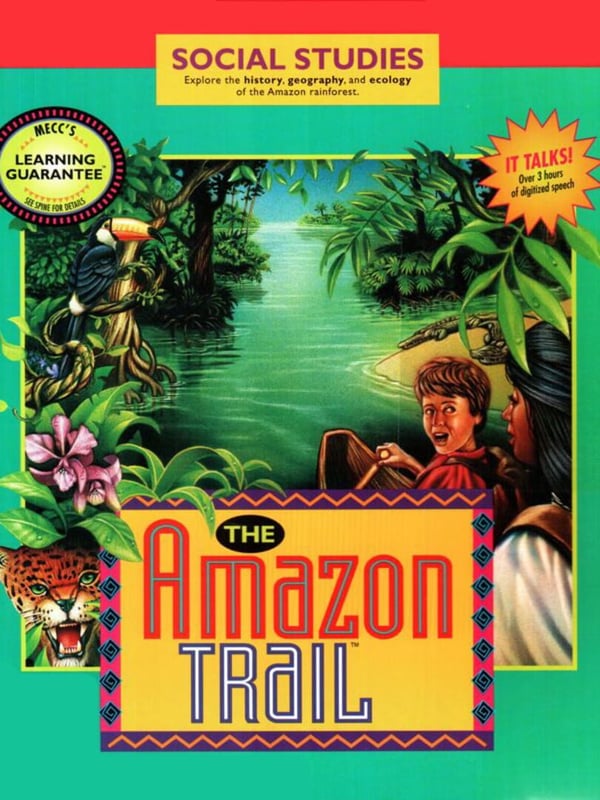
Amazon Trail arrived in 1993, a period when educational software for DOS-based PCs was flourishing alongside the commercial gaming market. It was developed as a spiritual successor to the beloved Oregon Trail series, transplanting the core formula of resource management and decision-making into the lush, dangerous environment of the Amazon River basin. Where Oregon Trail sent players westward across the American frontier, Amazon Trail tasked a single player with navigating a dugout canoe upriver through the Amazon, trading with indigenous villagers, fishing for food, and managing supplies to reach the ancient city of Machu Picchu. The game arrived at a time when DOS machines were well-established in schools and homes, and edutainment titles were a primary vehicle for teaching geography, ecology, and history to younger audiences.
Gameplay in Amazon Trail is structured around a series of sequential decisions and mini-game challenges. The player pilots a canoe along the river, encountering various stops — villages, trading posts, and points of natural interest — where they must barter goods, gather information, and replenish supplies. The fishing mini-game is one of the most memorable mechanics: players must time their clicks to cast and reel in fish from the river, with different species appearing depending on location and time of day. Successfully catching fish replenishes food stores, while failed attempts waste precious time. Trading with villagers requires careful attention to what goods are available and what each community values, introducing a basic supply-and-demand logic that rewards players who pay attention to dialogue and inventory.
The river journey itself is punctuated by hazards such as rapids and waterfalls, which demand quick reflexes to navigate safely. Failing to steer correctly can damage the canoe or injure the player character, depleting health and supplies. The game also incorporates a photography mechanic, encouraging players to photograph wildlife and landmarks they encounter along the route. These photographs serve both as in-game collectibles and as educational prompts, with the game providing factual information about the animals and ecosystems of the Amazon rainforest. This blend of action, resource management, and encyclopedic content was characteristic of the edutainment genre at its peak.
Visually, Amazon Trail made use of the color palette and resolution typical of early 1990s DOS software, presenting lush jungle backgrounds and detailed sprite-based characters. The audio, while limited by the hardware of the era, featured ambient sound effects that reinforced the tropical setting. In its era, the game was embraced primarily by schools and families seeking educational software that did not feel like a chore, and it earned a place in many classroom computer labs alongside its Oregon Trail predecessor. Its combination of genuine interactivity, factual content, and mild action challenge gave it staying power through the mid-1990s.
